
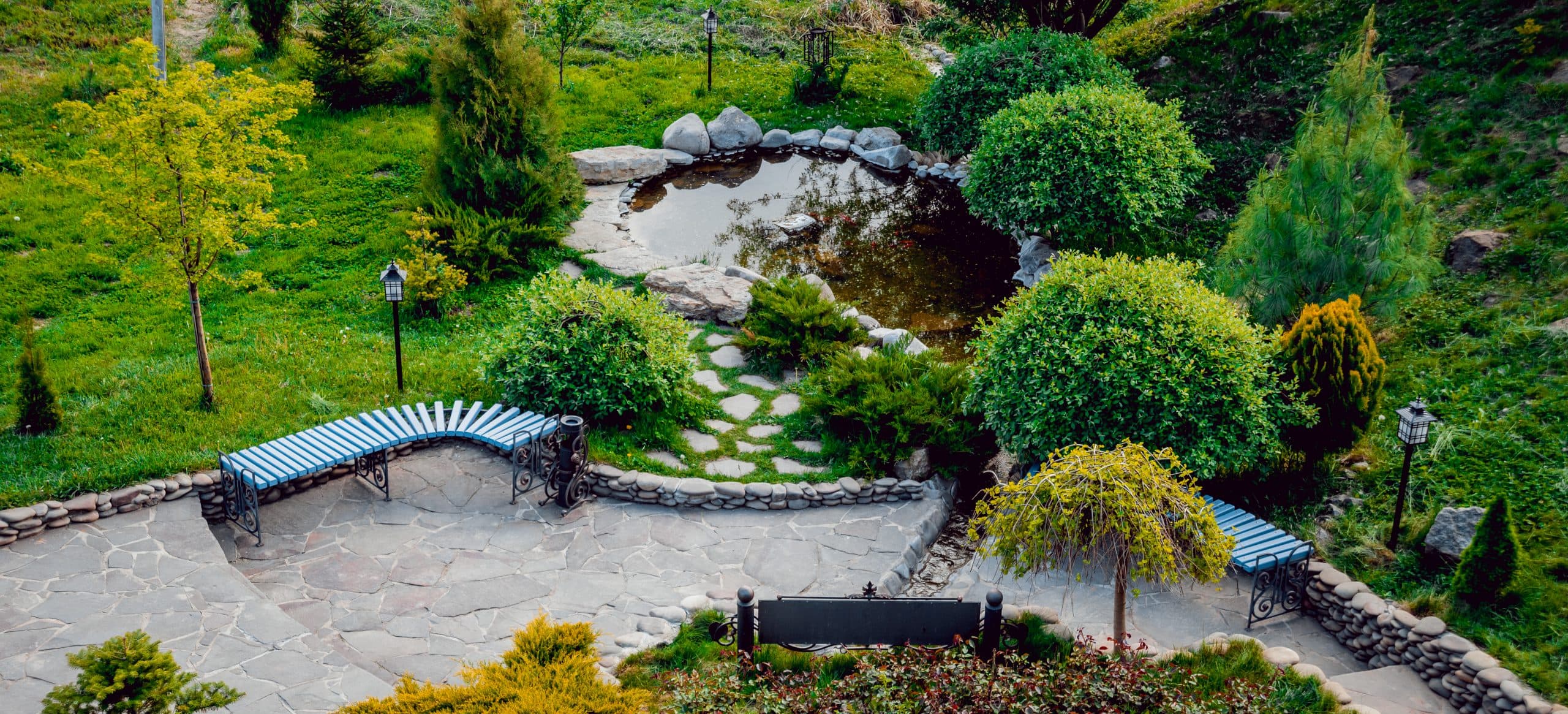
For comfortable living, rest, health, entertainment and recreational purposes, landscaped green areas are an essential living environment.
Contrary to the widespread belief that spring is the time for planning and planting, autumn is the right season for work on landscaping a home garden, terrace, balcony... Planning and planting in autumn also give you the chance to make “corrections” in spring. Anything you did not get round to planting, could not find seedlings for or forgot to plan can be put right in spring, so you do not miss the growing season and the enjoyment of the splendour of your garden.

Seedlings of ornamental plants and shrubs planted in autumn will root faster and better than those planted in spring. The risk of dying is lower. After autumn comes a long period of dormancy and stalled growth, which gives plants time to adapt and become stable. We must not forget that transplanting is stressful for a plant, and the risk of dying increases the older the seedling is. Transplanting in spring leaves the plant little time to stabilise before the exhausting leafing and flowering. If the root does not develop well, the plant will not develop properly either, flowering will be absent, and recovery may take many years or the plant may die completely. This is not a rule, but it is a possibility that autumn planting avoids.
If you plan to plant a hedge, it is important to decide what you want it to achieve. Protection from unwanted views, wind or noise will be achieved with a dense, tall hedge that is green all year round. For this purpose, in a continental climate, the best choice is common thuja or emerald thuja.
Common thuja, Thuja occidentalis, is a conifer that tolerates pruning well, and frequent pruning encourages its growth in width, making it denser. This hedge is also an excellent barrier against various animals.

Emerald thuja, Thuja occ. Smaragd, is also a fast-growing conifer from which a hedge can be shaped. It is distinguished by its bell-shaped habit and emerald green colour. A hedge of emerald thuja is more attractive than one of common thuja, but its formation takes longer. It is planted at a spacing of 1 to 1,5m, and the plants join into a hedge after a couple of years, once they have grown wide enough. Because of its exceptional beauty, emerald thuja is also an excellent choice as a freestanding shrub.
A hedge can also be decorative. It is most often planted to emphasise paths, steps or the edges of terraces, or as a barrier between a living area and a decorative garden. For this purpose it is best to choose lower shrub species.

Box, Buxus sempervirens, is a slow-growing shrub, green all year round, tolerates pruning very well and is often used to shape different forms and figures.
Green-leaved or red-leaved barberry, Berberis thunbergii Artopur- purea, are deciduous shrubs that tolerate pruning well and can be shaped in different ways. The lack of leaves in winter is made up for by an interesting tangle of thorny branches, which makes a barberry hedge impassable, so be careful and do not plant it near children's play areas.

For more information you can contact us by phone 033 428 665 or by e-mail: [email protected]