You choose a potato variety according to three questions: when you want to dig up potatoes, what you will use them for and what kind of area you are planting in. For young potatoes in June, very early and early varieties are chosen; for an autumn harvest and storage over winter, medium late and late ones; and for the household it is best to plant two to three varieties of different maturity.
It is equally important to plant declared seed potatoes, not potatoes from a cellar or from the market. Below we explain the differences between varieties and give an overview of the varieties from our range by maturity group.
Why plant declared seed potatoes?
Potatoes are propagated by tubers, so diseases, above all viruses, are passed from one generation to the next. Potatoes you saved yourself for seed every year give fewer and smaller tubers, even when they look healthy. Certified seed is produced under expert supervision, is health-checked and is of uniform size, so it emerges evenly and gives a reliable yield.
- Check the declaration on the bag: variety, seed category, tuber grading and producer.
- Edible potatoes from the shop are not intended for planting and are often treated against sprouting.
- Renew your seed regularly; it is best to buy new seed every year.
Early or late potato varieties?
Varieties are divided by length of growing season, from planting to maturity. As a rough guide, very early varieties arrive in 70 to 90 days, early ones in 90 to 100, medium early in 100 to 115, medium late in 115 to 130 days, and late ones take longer. Early varieties are intended mainly for fresh consumption, and later varieties for storage.
| Maturity group | Varieties from our range | Most common use |
|---|---|---|
| Very early | Colomba, Adora, Jaerla, Primabelle | Young potatoes, fresh consumption |
| Early | Carrera, Carlita, Liseta, Cleopatra, Red Scarlet | Early harvest, summer consumption |
| Medium early | Monalisa, Sylvana, Evora, Gioconda, Hermosa, Taurus, Memphis, Kondor | Summer and autumn consumption, shorter storage |
| Medium late | Desiree, Kennebec, Challenger, Fabula, Sifra, Ronaldo, Rashida, Flamenco | Main harvest, winter storage |
| Late | Agria, Panamera, Rosi | Storage, frying and baking |
Availability of individual varieties changes from season to season, so check the current range in the category seed potatoes or in the store.
Yellow, white or red potatoes?
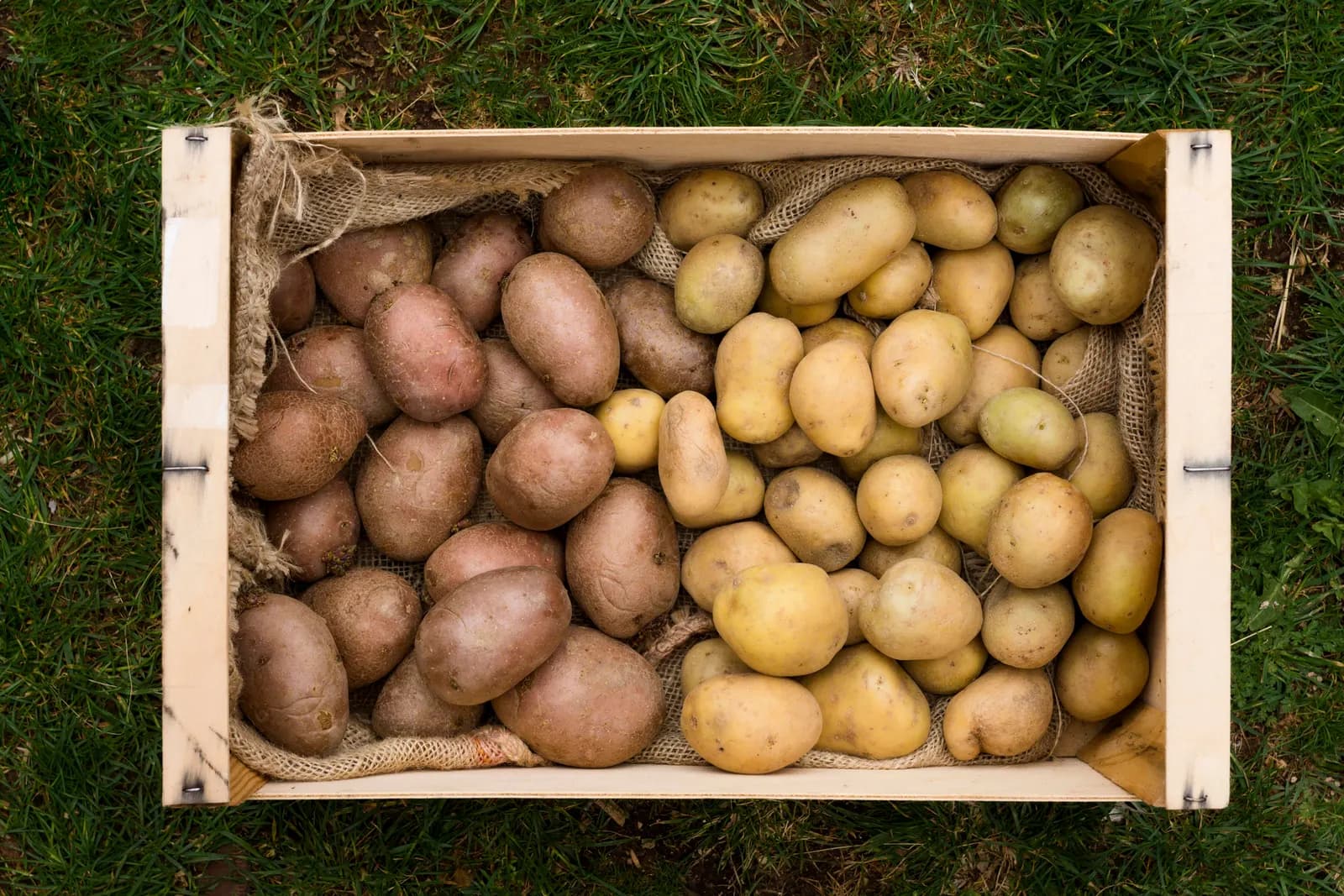
Skin colour is first of all a matter of customer habits and the market. Among the varieties with red skin in our range are, for example, Desiree, Red Scarlet, Cleopatra, Memphis, Kondor, Ronaldo, Flamenco and Rosi, while most of the others have yellow skin. Flesh colour ranges from white, as in the Kennebec variety, to yellow, as in Agria and Monalisa. If you sell potatoes, choose what your customers ask for. If you are planting for yourself, what matters more is how the potato behaves in the kitchen.
Which variety for boiling, baking and chips?
How a potato behaves when cooked depends mostly on its dry matter content. The higher it is, the floury the potato.
- Firm varieties (type A) stay whole after cooking. They are ideal for salads and boiled potatoes.
- All-purpose varieties (type B) are slightly floury and good for almost everything: boiling, baking, frying.
- Floury varieties (type C) fall apart easily when cooked. They are best for mash, oven baking and chips.
A few examples from the range: Colomba is a very early variety for young potatoes, boiling and salads. Primabelle stays firm after cooking and does not fall apart. Memphis is a red variety for boiling, salads and baking. Rashida is a versatile medium late variety for boiling, home-made chips and winter storage, while Panamera and Rosi are late varieties suitable for frying and chips. Agria is well known here as a yellow-fleshed variety that many choose precisely for chips and baking.
Which variety to choose for your area?
In lower and warmer areas planting starts earlier, so very early and early varieties for young potatoes pay off there. Summer heat and drought in these areas often shorten the growing season of late varieties. In hilly and mountainous areas, where summers are cooler and nights colder, medium late and late varieties intended for storage give the best results.
For a home garden a good combination is one very early or early variety for summer and one medium late or late variety for winter storage. This way the harvest lasts longer, and the risk of a bad year is spread across several varieties.
How much seed potato is needed?
For 100 square metres, plan on roughly 25 to 35 kilograms of seed, depending on tuber size and planting distance. The usual spacing is 70 to 75 centimetres between rows and 25 to 35 centimetres within the row. Smaller tubers are planted more densely, and larger ones more sparsely. Early varieties are planted slightly more densely than late ones.
- Buy the seed in good time, while the choice of varieties is greatest.
- Four to six weeks before planting, put the tubers to sprout in shallow trays, in a bright place at a temperature of 10 to 15 degrees.
- Plant when the soil has warmed up and dried sufficiently, with short, sturdy sprouts.
- Return potatoes to the same plot only after three to four years.
For more detail on soil preparation, fertilising and planting itself, read the article Preparing for potato planting.
Next steps
Decide how much area you are planting and in which period you want the harvest, then choose varieties from at least two maturity groups. Descriptions of all varieties, including those from the Dutch company HZPC, can be found in the category Potatoes, and organic and mineral fertilisers for basic fertilisation in the category Fertilisers and soil.
When planting time comes, an overview of the other spring tasks is in the calendar for March. For advice on choosing a variety for your area, contact the Agricom stores and garden centres. Addresses and contacts are on the Stores page.