
Modern life requires us to always be healthy and full of energy. Many people therefore first reach for medicines and dietary supplements in the form of tablets, and forget about the undemanding and tasty group of vegetables which, at least for milder illnesses, can replace medicines obtained artificially.
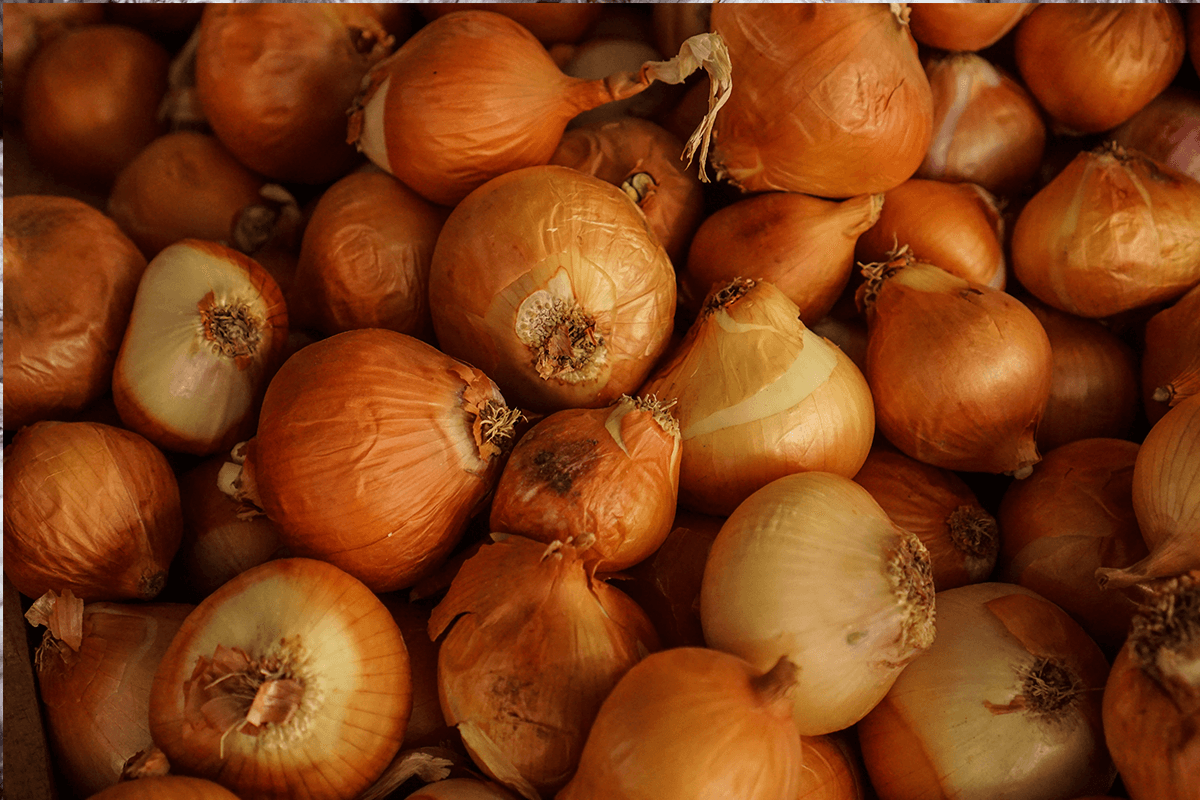
Onion (Allium cepa L.) is one of the oldest vegetable species. It is also known by the names: common onion, true onion, black onion, kapula. The homeland of the red onion is Central Asia; it probably originates from Afghanistan, Turkmenistan and Iran. It was brought to Europe in the Middle Ages via Italy. The underground bulbous stem consists of fleshy scale leaves, from the middle of which emerges the above-ground part of the stem, which is hollow and blue-green in colour. The leaves are sabre-shaped, long and flat. Greenish-white flowers are grouped into a spherical umbel. There are several varieties of onion, differing in colour as well as in size, shape and taste. The best known are:
Holandski žuti (Dutch yellow)
Stuttgarter Riesen, or Holandski žuti, is a medium early variety with round bulbs, of good yield, firmness and resistance. It is the most popular variety. It sprouts 18 to 24 days after planting. It is moderately pungent. Well dried after lifting, it stores well.
Ptujski crveni (Ptuj red)
Ptujski crveni is an onion that is becoming ever more popular: an early variety of burgundy colour, with elongated little bulbs and a round cross-section. It grows uniformly and is suitable for medium-long storage. It is used fresh. Because of its unusual colour it is very decorative.
Srebrnjak (White Lisbon)
Srebrenjak or White Lisbon is an early onion variety, white until the end of the growing season, with elongated heads, and of good yield. It stores poorly because of its low dry matter content. It contains essential oils, vitamins and sugar. Onion can be grown in almost any vegetable garden. It grows best on limestone soil, drier rather than wet. It has a sharp smell that causes tears. Its taste is aromatic, sweet and sharp. It is harvested from August to October, mainly the bulbs.
Medicinal action:
- it is an excellent diuretic (it effectively removes excess fluid from the body; it is recommended for people with rheumatism, arthritis, gout, for difficult urination and reduced kidney function,
- for inflammation of the urinary bladder (cystitis),
- it regulates digestion (it promotes the secretion of digestive juices), as well as the work of the intestines, and helps with constipation,
- for bronchitis and sore throat,
- it helps expel intestinal parasites (worms),
- it strengthens a weakened heart and restores strength to a weakened body,
- it lowers blood sugar levels.
Garlic, known locally as bijeli luk (Allium sativum)
We are aware that our immune system depends on the body's ability to respond to the influence of external factors, in order to protect itself from attacks by various diseases. Garlic, known among the people as bijeli luk (white onion), can certainly give us protection. Garlic is an annual herbaceous plant with a bulb (root) in the ground and a stem (with leaves) up to one metre high. In our region it is available for food all year round. Scientific research has established that garlic contains about 200 active substances, in concentrated form, and that most of them are in the bulb, although the flower, stem and leaves are also used in food. Garlic is rich in vitamins and minerals: adenosine, allicin, amino acids, plant fibres, plant fats, vitamin A, vitamins B1 and B2, vitamin C, iron, enzymes, essential oils, iodine, potassium, calcium, selenium, sulphur and phosphorus. It is used raw, cooked, as an addition to dishes, and also as a means of preserving food from spoiling. Garlic has become a universal folk spice and a preventive remedy. Among the people garlic is a remedy for everything, and there is great and unwavering trust in it. During various epidemics of typhus, cholera, plague, dysentery and flu, garlic above all was always recommended and used daily as a preventive and curative agent. More recently, garlic tablets and capsules are also made, so people who do not like its smell can use them too.
White garlic better than analgesics
Garlic is said to be the best natural remedy against viruses and colds, and its medicinal ingredients have been known since ancient times. Recommendations to use it daily are especially topical in the winter period. The most important ingredient of garlic is ajoene, whose effect is better than that of aspirin, which acts by producing less thromboxane. But ajoene, besides that action, has seven more ways of preventing platelets from sticking together and forming a clot. Garlic also contains adenosine, which also acts against blood clotting, and not only preventively: it also has the ability to dissolve clots that have already formed. Regular use stimulates blood circulation and eases the flow of blood, lowers raised blood pressure and blood fats. It is an excellent antioxidant, so it protects the body from the action of free radicals. In general, it has a favourable effect on the immune system, slows down the ageing of the body and strengthens resistance to infections. It is enough to eat two to three cloves of garlic per day to achieve its antithrombotic effect.
Onion pests
The biggest pest of the onion crop in our area is the onion fly (Latin: Delia antiqua). It usually appears during wet springs. The most dangerous is the first, spring generation, which attacks still undeveloped plants. The damage is caused by a larva that feeds on the contents of the stem from inside. At the points of damage, soot fungi (Gloeodes pomigena) develop, which cause the plants to rot.
In the field an attack by the onion fly is easy to recognise: attacked plants begin to wilt suddenly, leaves turn yellow, the central leaf dries and is slowly pulled out of the stem. If you cut such a plant lengthwise, you will find several onion fly larvae. In a heavy attack one plant may contain up to 50 larvae. However, a single larva in a young onion stem is enough to cause rotting. An exceptionally effective solution against the onion fly has proved to be Bio Plantella yellow sticky boards. They are an excellent mechanical and completely natural protection of plants against a wide range of plant pests in the vegetable garden and on fruit trees.
Tips for growing onions
Onion adapts very quickly to different climatic conditions. It is used as young onion, where the whole plant is used, or when fully mature, when only the bulb is used. It contains the most carbohydrates, mineral substances Ca, Mg, Mn, Fe, Al and vitamins B1, B2, C, E, K and provitamin A, and bacteriostatics. The quality of the onion is influenced by: choice of variety, irrigation, planting time, fertilising, harvest time, as well as temperature and light. It germinates at a temperature of 2-3℃; it needs water in the initial phase, from emergence to the formation of leaves, while in the late stages of development the need for water decreases. Excessively high humidity leads to the formation of large bulbs, but of lower quality, and the ripening of the bulbs is often prolonged. For longer storage, varieties with more dry matter are better, of which the variety Stuttgarter Riesen (Dutch yellow) stands out as the most sought after. It is harvested when about 50-60% of the bulbs have fallen over. It ripens at the end of July and the beginning of August. Before storage the onion must be dried well. More information about the seed onion varieties available in our range can be found at this link.
Note: This article is informative in nature, is not connected with the current epidemiological situation and is not intended to give any advice on ways of preventing and treating the coronavirus (COVID-19). The World Health Organization (WHO) draws attention to the fact that, although white garlic has a certain antimicrobial action, for now there is not a single scientific proof that confirms this vegetable prevents infection with the COVID-19 virus.