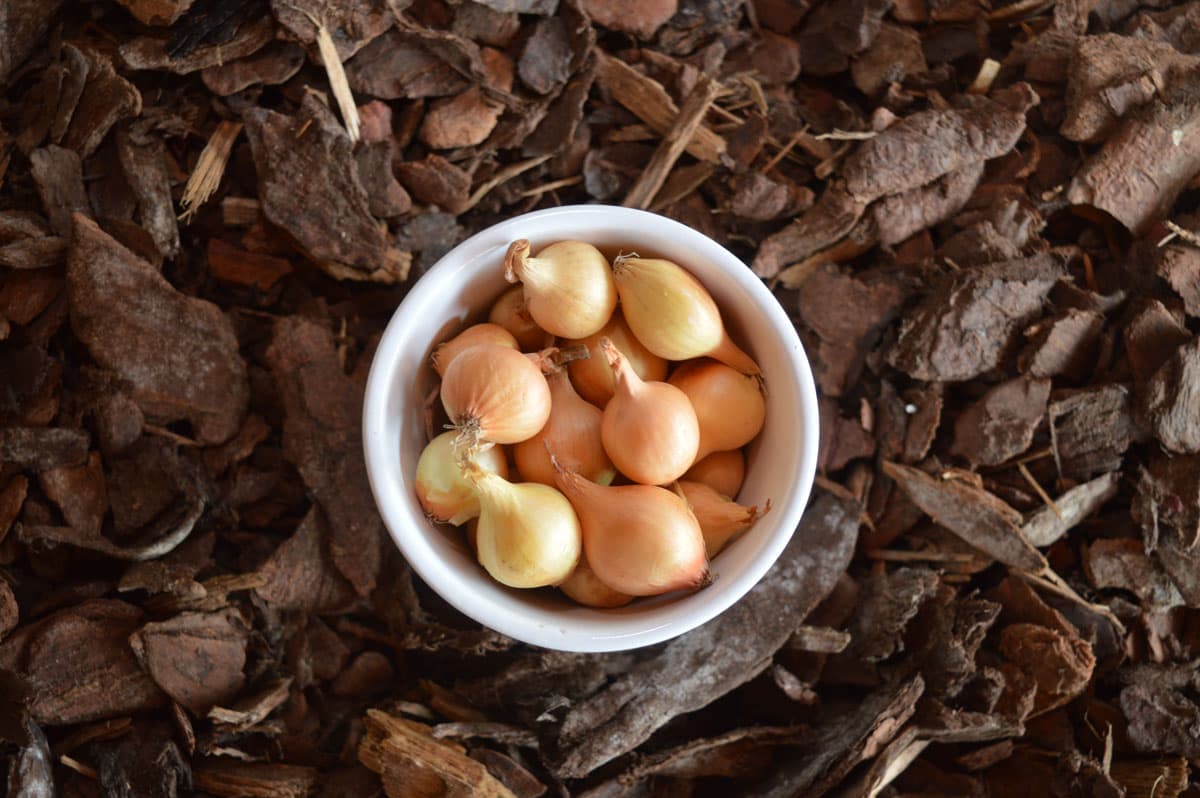
Onion is a vegetable crop with moderate heat requirements, so it can also be grown by autumn planting. It tolerates low temperatures better than most other vegetable crops, so with proper production technology, in some dry years autumn planting can give even better results than spring planting.
With autumn planting, onion is grown from bulbs, so the varieties used are those that reproduce from bulbs. For autumn planting, deep, well-drained soils of lighter texture that are rich in organic matter are suitable. Heavy soils that are poorly permeable to water are unfavourable during winter, because due to poor drainage water may stand for a shorter or longer period and destroy the crop.
Planting time
The optimal time for autumn planting of onions is the second half of October. From such planting the plants will manage to root well before winter and prepare for overwintering.
Planting too early means the plants may enter winter overdeveloped, which greatly reduces their ability to overwinter, while planting too late means they will not root enough, so winter frost heaving damages them much more easily. On larger areas, onion sets are planted mechanically with planters onto previously prepared beds or onto flat ground, and by hand in the garden. On prepared beds the onion bulbs are planted in rows with a spacing of 25-30 cm. The spacing of the planted bulbs within the row should be 8-10 cm.
Onion varieties
In our range you can find four onion varieties for autumn planting:

Izborak
Izborak onion is a variety that is planted in autumn. Because of its characteristics it is regularly grown in our area. Harvesting can be done several times, since one bulb gives several shoots. Onion greens are used fresh for preparing salads and other dishes.

Ptujski crveni
Ptujski crveni is a late variety with purple outer leaves. The bulbs are round in shape, 6-7 cm high and 7-8 cm in diameter. It has a mildly pungent taste, firm outer leaves and a dry matter content of about 12%. Properly stored, it keeps well over a longer period.

Srebrenjak
Srebrenjak is an early variety of round, flattened heads with an average weight of about 50 g. The heads are wrapped in white outer leaves. The inside of the head is white, and the taste is sweetish. It is intended primarily for early spring consumption in fresh form.

Stuttgarter
Stuttgarter is a variety of onion with flattened heads and yellow-brown outer leaves. The heads are quite firm with a well-closed top. They are relatively large, with an average mass of 80 to 90 grams. The inside of the head is white and of moderate pungency.
Planting onions in polytunnels
In 1 kg of onion sets (arpadžik) of grading 8-21 mm there are 300 to 320 bulbs, and in 1 kg of izborak there are about 120 bulbs. The soil must be prepared and fertilised with 0,5 kg/m² of Plantella Organik fertiliser, with the addition of 20-30 g of NPK 15-15-15.
Onion is planted at an inter-row spacing of 10 to 20 cm, and densely within the row at 3 to 5 cm. Within the row leave enough spacing so that the bulbs do not compete with each other, that is, so that they are not smothered as they grow. When planting it is not necessary to plant deeply. For planting, it is best to use bulbs with a diameter of 20×30 mm or 14×21 mm.
The sowing rate is 7-10 kg/m² depending on the size of the bulbs. After planting, it is best to water the onion with lukewarm water, in an amount of 10 l/m², because in the initial stages onion needs more moisture for faster emergence. The soil must be kept moist so that the onion emerges uniformly, but one should not overdo it, so that disease does not develop.
The optimal temperature to maintain in the polytunnel is between 15 and 20 °C, and relative air humidity around 70%. Planted onions in the polytunnel should be fed twice during the growing season with the nitrogen fertiliser KAN, in an amount of 20-30 g/m2.
Tips for professionals
Do not plant the whole quantity of onions at once, but do it at intervals of 8 to 15 days, so that it is ready for harvest at different times and so that you can bring it to market several times. Young onions are harvested when they are 30-40 cm high, which is the period 35-50 days after planting. The yield of young onion can be up to 15 kg/m².